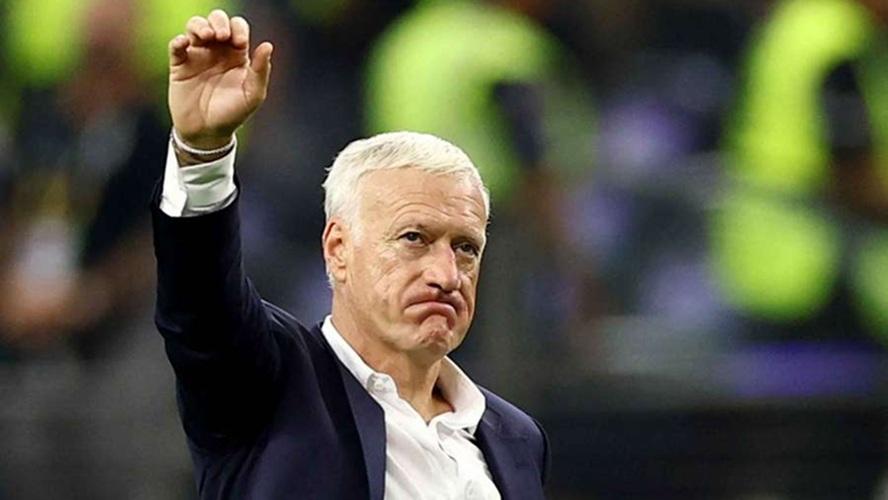
Deschamps Helpless, Spain Wins over France in Cup Semifinals
July 15, 2026 ·
Spain's 2-0 win over France in the World Cup semi-finals showed Didier Deschamps' strategic mismatch with his existing players, ending in a bitter decision towards the end of his tenure.
Deschamps Helpless, Spain Wins Over France in Cup Semifinals
According to Soccernews.
Background
This defeat was an important moment for France, who were previously known for their explosive attacks. However, in this match, they were only able to get three shots on target, showing a lack of effectiveness up front. With a star player like Kylian Mbappe, hope for the team's future remains, but there needs to be a significant change in tactical approach.
Why this is important
This defeat reflects the mismatch between Didier Deschamps' strategy and the abilities of the existing players. This moment could be a turning point for the French team ahead of the 2026 World Cup, where they will have to evaluate their approach and line-up to compete at the highest level. With Deschamps expected to step down, the future of the French national team faces new challenges.
Main Points
- Deschamps Helpless, Spain Wins Over France in Cup Semifinals.
- Spain's 2-0 win over France in the World Cup semi-finals showed Didier Deschamps' strategic mismatch with existing players, ending in a bitter decision towards the end of his tenure.
- Didier Deschamps remains central to France's plans.
The World Cup semi-final match in Dallas ended with Spain's 2-0 win over France, which felt more like a tactical lesson than a tight result between two elite teams. France came in as the team with the most explosive attack of the tournament, but Didier Deschamps and his team left the pitch with little to show for it, managing just three shots on target and constantly being shut out by Spain who never seemed to be under any serious pressure. Although Spain deserves great credit, France also contributed greatly to their own downfall.
Deschamps chose a line-up that seemed trapped between two different strategic ideas. If he wanted to dominate possession and compete in the middle with Spain, he chose the wrong personnel. If he wanted to exploit Spain with speed and directness, France rarely committed to that approach. Eventually, they found themselves in the middle of discomfort — and Spain was happy to take advantage of it. With Deschamps expected to step down from his position, this is clearly not a fitting end to his glorious tenure with the French national team.
The initial structure of the team describes the problem. France fielded Aurelien Tchouaméni and Adrien Rabiot as a double pivot behind Michael Olise, while Arsenal-linked Ousmane Dembele and Bradley Barcola filled the flanks around Kylian Mbappe. At first glance, this choice suggests that Deschamps wants to control the center. After all, against Spain, the fight usually starts in the middle.
Luis de la Fuente's teams are built on technical excellence, a combination of short passes, positional rotation and the ability to surround opponents through possession. Spain entered the semifinals with the strongest defensive record in the tournament and have repeatedly demonstrated their dominance through central control.
The problem is very clear. Among French midfielders, Olise is the only true technician capable of receiving the ball under pressure, evading markers and creating advantages through combination play. Rabiot and Tchouaméni are great midfielders, but neither is a specialist in receiving the ball in tight spaces and controlling the tempo against elite pressing. Their strengths lie elsewhere — defensive closure, ball progression, physical presence and tactical discipline. Spain immediately understood this. Once Olise became the focal point of France's offensive build-up, Spain easily prevented him from operating. The results were predictable. France struggled to link the midfield with attacks, while Spain slowly tightened control over the rhythm of the game.
The most frustrating aspect for France supporters is that alternatives actually exist. Had Deschamps really wanted to challenge Spain technically, a forward structure consisting of Desire Doue on the left, Olise on the right and Rayan Cherki as a creator in the middle would have certainly presented Spain with a very different problem. These three players are comfortable receiving the ball under pressure. They are able to play in tight spaces and manipulate defenders rather than just attacking open spaces. Most importantly, such a trio would enhance France's ability to overload Spain's midfield and half-spaces, forcing uncomfortable defensive decisions from wing-backs Pedro Porro and Marc Cucurella. Spain were able to maintain their defensive shape so well throughout the semifinals largely because France lacked players capable of coordinating in the middle. Cherki's entry finally highlighted this issue. Even in limited time, he immediately offered the passing angles and combinations that were missing for much of the match. However, by that time, Spain was in complete control.
Alternative approaches seem even more attractive. If Deschamps wants Dembele and Barcola playing together, why try to fight for possession at all? France's greatest weapons are speed and verticality. Few teams in world football can match the transition threat created by Mbappe, Dembelé and Barcola when attacking open space. Spain, despite their brilliance, generally defended with a high line and sent many players forward during possession. That should present an opportunity for Deschamps' side. Instead of trying to build attacks patiently through a struggling midfield, France might have been better off attacking straight into the wide channels. Early vertical passes, quicker transitions and the courage to get past Spanish midfield pressure can force Spanish defenders into an uncomfortable race. Ironically, the personnel on the field seem perfectly suited to that style. Inappropriate tactics. France spent too much time in the match trying to build attacks through areas where Spain was strongest instead of targeting spaces where Spain might be vulnerable.
However, all this does not reduce Spain's performance. The midfield unit of Rodri, Fabian Ruiz and Dani Olmo controlled almost every phase of the match. Each is assigned to do what they do best. Their pressing was coordinated, their circulation of possession was relentless, and their defensive structure prevented the French wingers from accepting isolated one-on-one situations. Spain's first goal came from sustained pressure before Mikel Oyarzabal scored a penalty after Lucas Digne fouled Lamine Yamal. Pedro Porro's goal in the second half effectively ended the match, while highlighting the only extenuating circumstance for Deschamps. The player most responsible here was Maxence Lacroix, who came off the bench after half an hour to replace William Lintasa. With all due respect to the Crystal Palace defender, the gap in quality between him and the Arsenal stalwart is quite large. One might ask why Deschamps chose Lacroix to come in and not Ibrahima Konate, but one look at the season Real Madrid's new defender has had with Liverpool may provide the answer.
However, perhaps the most striking aspect of this match wasn't the score, or the defensive issues. But how little France created chances. Spain limited one of the most feared attacks of the tournament to almost nothing. France only produced 0.3 expected goals despite the quality of players available. It doesn't happen just because one team plays well. It happened because the other team never found a coherent attacking identity.
Football matches are rarely decided when the line-ups are announced. However, this match may be. Deschamps appears to have chosen a midfield that can compete physically with Spain, but not technically. He opted for wingers capable of devastating transition attacks, but France rarely fully committed to a transition-based game plan. The result is a team that lacks the creativity to dominate possession and lacks the directness to exploit space. The Spanish immediately recognized this contradiction, and once they gained control, they never relinquished it. For all the talk about Oyarzabal's penalty, Porro's finish, or Spain's incredible defensive display, this semi-final may have been defined by a simpler truth: France went into the match with the wrong plans for the players they chose. Against most opponents, those mistakes are survivable, even correctable. However, against Spain, it turned out to be fatal.
What happened next
With Deschamps likely to leave his position, the French football federation needs to quickly find a replacement who can bring a new vision to the team. A thorough assessment of players and strategy will be crucial to rebuilding the team's confidence ahead of the upcoming competition. Meanwhile, Spain will look to continue their positive momentum, which could have a big impact on their progress in this tournament.
Frequently Asked Questions
Who won the World Cup semifinal match between France and Spain?
Spain won 2-0 over France.
What impact will the result of this match have on France's position in the World Cup table?
This defeat ends France's journey in the World Cup, and they will not continue to the final.
How many shots on target did France have in this match?
France was only able to fire three shots on target.
Who is the coach of the French team that faces Spain in the semifinals?
The coach of the French team is Didier Deschamps.
What's the next game for Spain after beating France?
This article does not mention Spain's next match.
Related News
- Mbappe Overcomes Giroud and Fontaine: Becomes France's Best Goal Scorer
- FIFA Asks Egypt to Remove 7 Stars from Coat of Arms for 2026 World Cup
- France vs Senegal: How to Watch, TV Channel, Live Broadcast
- Japan Rises Twice to Draw Against the Netherlands in the World Cup
- 2026 World Cup: England Face Tough Challenges in Group L